
Se incarca...
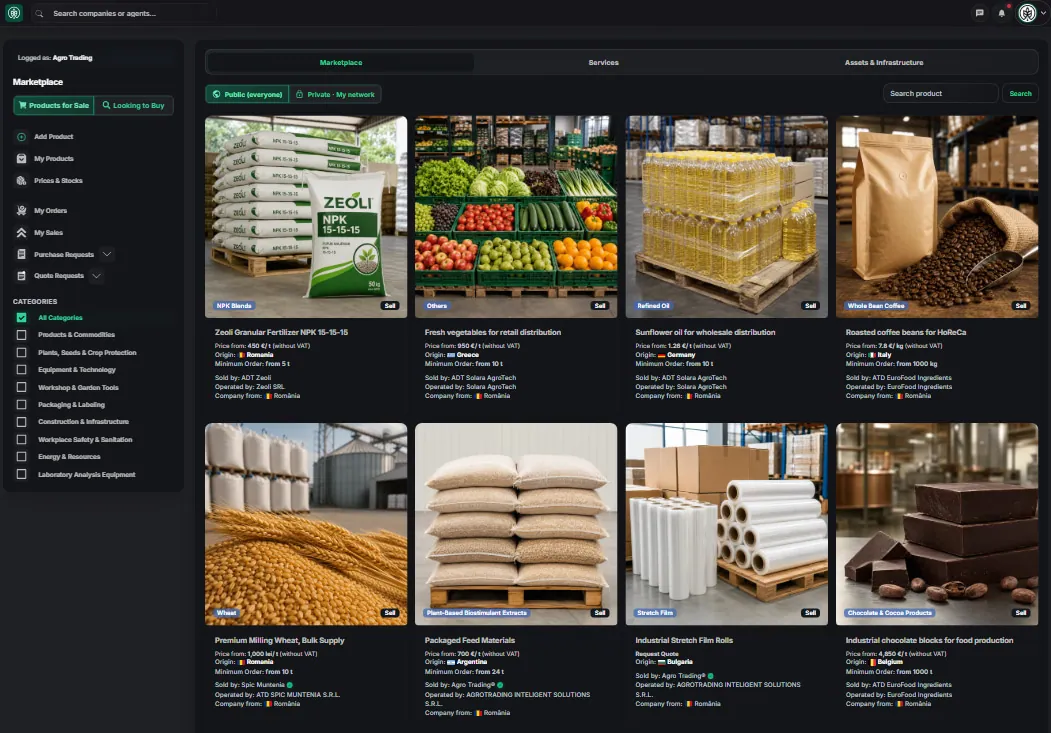
The AgroTrading Marketplace is publicly presented as a structured digital space organized into four zones — Products, Services, Assets and Infrastructure, and Private Marketplace — built for direct B2B collaboration between validated companies. This page explains how these zones are organized at the category and subcategory level, so that economic operators can understand the semantic logic of the ecosystem and how they can classify their activity.
Listings in the marketplace can include offers, requests or donations, and negotiation takes place directly between partners. AgroTrading does not intermediate payments, does not charge commissions on transactions and does not become a party to commercial contracts between companies. The purpose of this page is informational and aims to clarify the marketplace structure for users and for relevant B2B searches.
In the products and raw materials area, AgroTrading can also be understood as a B2B agricultural marketplace, integrated into a broader ecosystem that includes services, assets and infrastructure.
The AgroTrading Marketplace is a digital environment where validated companies and organizations can communicate offers, requests and donations across B2B categories of products, services, assets and infrastructure. The platform facilitates direct commercial relationships between legal entities, without payment intermediation and without guarantees regarding transactions.
The AgroTrading Marketplace is organized into four main zones — Products, Services, Assets and Infrastructure, and Private Marketplace. The first three zones are those that publicly structure the majority of categories and subcategories useful for guiding companies within the digital ecosystem.
This organization helps economic operators quickly understand where the products, services or assets relevant to their activity fit. At the same time, the structure contributes to the semantic clarity of the platform and to easier navigation through the presentation content.
The marketplace serves to create a digital framework for communication and organization for direct commercial relationships between companies. It supports the publishing and presentation of listings, without taking on the role of broker, financial intermediary or contractual guarantor between parties.
Decisions regarding sales, purchases, negotiations and collaboration belong exclusively to the members involved. The platform provides the digital infrastructure for presentation and interaction, and commercial relationships are established directly between the participating legal entities.
B2B offers and requests can be associated with product, service, asset and infrastructure categories to facilitate searching, filtering and thematic classification of listings. The semantic structure described on this page reflects the internal taxonomy in an editorial form, useful for guiding companies and for understanding the thematic areas covered.
The presentation website does not function as an exhaustive catalog of listings. Its role is to logically explain the categories and subcategories and to help companies understand how their content can be organized within the platform.
The Private Marketplace is publicly mentioned as a distinct zone within the AgroTrading ecosystem. In this zone, certain listings may have restricted or targeted visibility, depending on relationships and settings available in the network.
This page does not detail the internal configuration rules, but explains that the category structure also applies in the private marketplace zone. The basic principle remains the same — direct B2B collaboration between validated companies, within an organized and clear framework.
The marketplace operates in conjunction with other ecosystem components, such as the digital warehouse, dedicated messaging, automatic translation and document management associated with platform use. These elements contribute to an integrated working framework for companies organizing their activity within the AgroTrading environment.
The category structure serves to organize information and create a clear basis for understanding listing types and collaborations. It complements the functionalities presentation without replacing the rules and detailed processes from the application.
This subcategory brings together the main groups of B2B goods communicated on the platform, from agro raw materials and processed food products to beverages, bee products, animal husbandry, aquaculture, feed and crop inputs.
The services zone covers areas such as consulting, agriculture, processing, logistics, marketing, infrastructure, energy, environment and technology, with a focus on professional collaborations between legal entities.
This subcategory includes land, buildings, infrastructure projects, commercial vehicles, heavy machinery and agricultural machinery, organized to describe types of assets relevant to economic activities.
The Private Marketplace represents the zone where certain listings may be accessible in a more restricted or targeted manner, with a category structure similar to other zones but with visibility configurable based on network relationships.
The Marketplace page is intended for companies and organizations analyzing how they could use the AgroTrading platform for communicating offers, requests or donations in a B2B context. It is useful for sales, procurement, marketing, management and business development specialists who need to understand the marketplace structuring logic before deciding how to position their listings in the ecosystem.
The Marketplace category serves to clarify the main architecture of the AgroTrading ecosystem and to explain the relationship between Products, Services, Assets and Infrastructure, and the Private Marketplace. This clarification supports coherent platform usage, without replacing legal documents, contractual terms or operational instructions from the application.
The information included on this page serves a descriptive role and does not constitute contractual commitments or guarantees regarding marketplace operation. Actual configurations, listing types and usage modes may vary depending on account, subscription and the legal framework applicable to each company.
Today's decisions define tomorrow's collaborations.


